Non classé

When is URS a strategic option for trademark owners?

Introduction

The Uniform Rapid Suspension (URS) procedure is particularly effective when the primary goal is to stop a clear trademark infringement quickly through a domain name, without initiating a heavier procedure aimed at transferring the domain. It complements the UDRP by offering a faster and generally less expensive route, but with a deliberately limited remedy: suspension (not recovery) of the domain name.

URS: what the procedure can do (and what it cannot)

The promise: fast suspension, no transfer

URS allows a trademark owner to file a complaint for infringement of its rights, leading to the temporary suspension of the disputed domain name without any transfer of ownership. The suspension remains in place until the end of the registration period, after which the domain name is expected to become available again.

Strategic implication: URS is ideal when the priority is to stop a fraud or abusive use, rather than to recover a digital asset.

The standard: a procedure reserved for “clear-cut” cases

URS is designed for the most obvious infringements. It is not comfortable territory where the file involves a serious factual or legal dispute (plausible competing rights, potentially descriptive use, broader commercial dispute). This approach is expressly supported by ICANN: URS is intended as a fast-track mechanism for clear cases.

The three elements to prove (the “three-part test”)

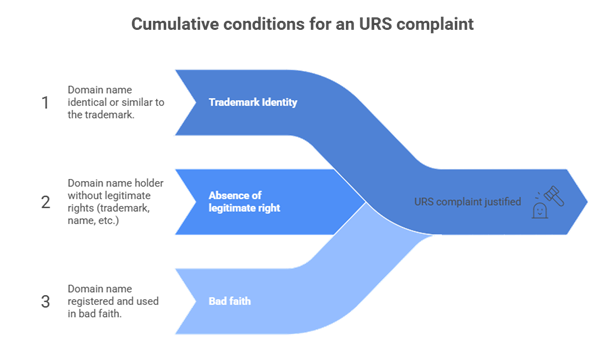
To succeed in an URS complaint, the complainant must establish three cumulative elements:

  • The domain name is identical or confusingly similar to a word trademark or figurative trademark owned by the complainant (a valid national/regional registration in current use, or judicially validated), and the complainant must be able to prove both the registration and the use;
  • The domain name holder has no legitimate right or interest;
  • The domain name was registered and is being used in bad faith.

condition urs complaint

Which Top-Level Domains (TLDs) are eligible for URS?

Before recommending URS, it is essential to verify the eligibility of the relevant extension, as URS is not intended to apply indiscriminately to all TLDs. As a rule, URS was designed for the new gTLDs introduced under the ICANN program, meaning it primarily applies to domain names registered under those new extensions. Conversely, for legacy gTLDs (for example, .com, .net, or .org), URS is not automatically available and the “standard” route generally remains the UDRP.

There are, however, specific cases: certain so-called “legacy” extensions have incorporated URS following amendments or renewals of their Registry Agreement, so that an extension historically “outside URS” may become eligible depending on the applicable framework. In practice, the most robust approach is therefore to confirm, on a TLD-by-TLD basis, whether URS is available, and then to choose between URS and UDRP depending on the objective pursued (rapid neutralization or transfer).

When URS is strategically better than the UDRP

1) Phishing, fake shop, impersonation: neutralization comes first

When the domain name is used for fraud (phishing, payment pages, a fake store replicating the trademark, misleading redirects), the economic priority is often to stop the abuse before anything else. In this context, URS is strategic because it specifically targets obvious abuse and can lead to rapid suspension.

2) Short-window campaigns: sales, launches, events

Where infringement is opportunistic (Black Friday, holiday season, product launches, influencer-driven campaigns), the key issue is not the ownership of the domain name but the loss of revenue and consumer confusion over a short time frame. URS is then a proportionate response: fast, tailored to obvious cases, and compatible with a multi-channel enforcement strategy.

3) Volume: “cloned” series of registrations (same pattern, same actor)

URS is also relevant where multiple domains follow the same abusive pattern: trademark + generic term, typos, geographic variants, or multiple extensions. Providers offer fee schedules adapted to volume, which can make URS economically rational in “anti-raid” operations.

4) When transfer offers no immediate value

If the domain name has no real portfolio value (no marketing value, no “clean” traffic, no portfolio coherence), pursuing a transfer under the UDRP may be disproportionate. URS allows us to cut the abuse and let the domain expire, with a possible one-year extension if needed.

Limitations: when URS is not the right tool

1) Where recovering the domain name is a business issue

URS does not transfer ownership. If the domain name is strategic (trademark + core business term, product name, recurring campaign name), the UDRP (or a national procedure) is more suitable, as it can result in a transfer.

2) Where there is a serious dispute

URS is designed to exclude “debatable” situations. If a potentially legitimate use exists (criticism site, parody, descriptive use, plausible prior rights, contractual dispute), the URS complaint may be denied, as the examiner must reject the complaint whenever a substantial factual dispute arises.

3) Where evidence of trademark use is weak

URS requires a clean file (rights, use, bad faith, lack of legitimate interest). Operationally, the procedure is strict and leaves little room to “fix” weaknesses afterwards: an incomplete or poorly structured filing can significantly undermine the case.

Conclusion

URS is a strategic route when a rapid response is required, focused on neutralizing a clear infringement, on an eligible TLD, with an evidentiary record capable of meeting the clear and convincing evidence standard. Conversely, as soon as the goal is to recover the domain name, or where a serious dispute is foreseeable, the UDRP (or a targeted court action) becomes the natural option again.

It is also advisable to strengthen your upstream framework through an integrated strategy combining targeted filings for key signs, continuous monitoring of risky registrations and content, and a graduated response depending on urgency (notice, takedown requests to intermediaries, then URS or UDRP where suspension or transfer is required).

Dreyfus & Associés assists its clients in managing complex intellectual property cases, offering personalized advice and comprehensive operational support for the complete protection of intellectual property.

Dreyfus & Associés works in partnership with a global network of attorneys specializing in Intellectual Property.

Nathalie Dreyfus with the support of the entire Dreyfus team


Q&A


1. What is the deadline to respond to an URS complaint?

In principle, the respondent has 14 calendar days to file a response.

2. What level of proof does URS require?

The complainant must prove its case by clear and convincing evidence and show that there is no substantial factual dispute.

3. How much does an URS proceeding cost?

Costs depend on the provider and the number of domain names involved. By way of indication, centers such as Forum, ADNDRC, and MFSD publish fee schedules: for a straightforward case (1 domain), fees usually start at a few hundred, then increase by tiers or with an additional per-domain fee.

4. Is there an appeal mechanism under URS?

Review/appeal mechanisms exist under the URS rules and the provider’s supplemental rules (deadlines, fees, conditions).

5. In which cases is URS not recommended?

Where the objective is transfer, or where the case raises serious factual or legal issues (potentially legitimate use, credible competing rights).

This publication is intended for general public guidance and to highlight issues. It is not intended to apply to specific circumstances or to constitute legal advice.

Read More

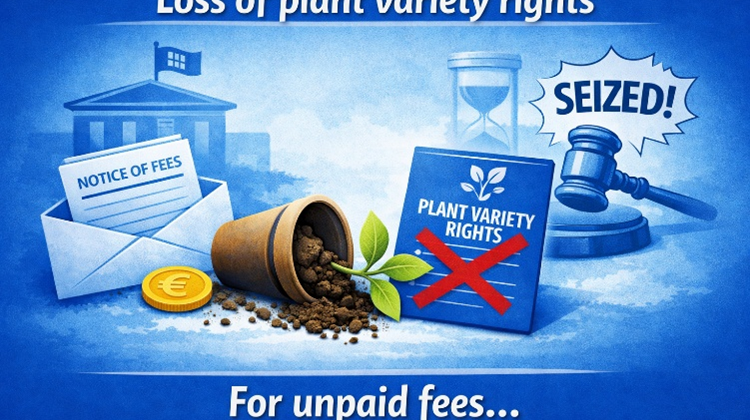
Losing a plant variety right for an unpaid fee: a risk confirmed by the CJEU?

Introduction

The decision delivered by the Court of Justice of the European Union on September 2, 2025 (Case C-426/24 P) marks a decisive turning point in the management of Community Plant Variety Rights (CPVRs). By confirming the definitive cancellation of a right for non-payment of an annual fee, the CJEU forcefully reiterates that the protection of plant innovations depends as much on the legal robustness of the title as on the administrative discipline of its holder.

This ruling, with major practical implications for breeders, seed companies, and agri-industrial groups, calls for a strategic and operational reading of plant variety protection law in the era of dematerialisation.

The legal framework governing the payment of fees in plant variety protection

The fundamental principle of maintaining the right

Regulation (EC) No 2100/94, which establishes the Community system for the protection of plant varieties, is based on a clear balance: in return for an exclusive right of exploitation, the holder must pay an annual maintenance fee.

In principle, failure to pay this annual fee within the prescribed time limits results in the definitive forfeiture of the plant variety right, save for limited circumstances in which the holder demonstrates, pursuant to Article 80 of Regulation (EC) No 2100/94, that an involuntary, exceptional, and duly justified impediment prevented compliance with the deadline.

A logic comparable to other intellectual property rights

Like patents or trademarks, a plant variety right is a living right, dependent on continuous vigilance. However, the specific feature of the CPVO system lies in its European centralisation and the growing use of digital tools dedicated to relations with right holders, in particular the MyPVR electronic platform, used for the notification of official acts, deadline management, payment of annual fees, and procedural exchanges with holders.

The Melrose case: a landmark dispute before the CJEU

The facts giving rise to the dispute

Romagnoli Fratelli SpA, the holder of a Community plant variety right for the potato variety Melrose, failed to pay the annual fee within the prescribed time limits.

The CPVO (Community Plant Variety Office) had nevertheless issued a debit note and several reminders, all made available via the MyPVR platform, with notifications sent by email.

The attempted restitutio in integrum

The holder applied for restitutio in integrum under Article 80 of Regulation (EC) No 2100/94, arguing that it had been prevented from meeting the payment deadline due to the lack of effective receipt of the notifications and contesting the validity of MyPVR as an official means of communication.

These arguments were rejected successively by the CPVO, the General Court of the European Union, and ultimately by the Court of Justice of the European Union, which held that failure to consult electronic notifications does not constitute an involuntary impediment within the meaning of Article 80.

Validation of electronic communications via MyPVR

An explicitly recognised legal basis

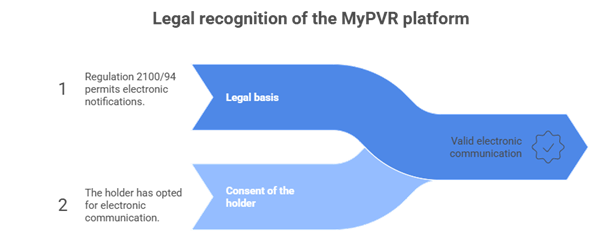
The CJEU confirms that the President of the CPVO is empowered, under Regulation 2100/94, to determine the modalities of electronic notification. Accordingly, the MyPVR system is recognised as an official and legally valid channel for the service of acts.

The importance of the holder’s consent

A decisive factor lies in the fact that the holder had opted for electronic communication. This choice entails clear legal consequences: failure to consult the platform cannot invalidate the notification.

legal recognition plateform

Burden of proof and the holder’s heightened responsibility

A firm position of the CJEU

The Court unequivocally states that the burden of proof lies with the holder. It was for the holder to demonstrate that the documents had not been made available in its MyPVR space or that the notification emails had not been sent. Failing such proof, the notification is presumed valid.

A heightened duty of diligence

This approach enshrines a logic of proactive responsibility: not seeing a notification does not mean it does not exist.

The CJEU thus elevates the administrative management of a CPVR portfolio to a strategic obligation, inseparable from legal protection.

Essential best practices for holders of plant variety rights

To avoid irreversible losses, we notably recommend:

  • Regular monitoring of MyPVR;
  • Continuous updating of electronic contact details;
  • The implementation of redundant internal alerts;
  • The use of a professional representative for portfolio management.

Conclusion

The CJEU decision of September 2, 2025 starkly illustrates the cost of administrative negligence in plant variety protection law. Failure to pay an annual fee, even in the absence of bad faith, may result in the definitive loss of a right of significant economic value. In a digital environment fully embraced by European institutions, vigilance is no longer optional; it is the very condition for the sustainability of rights.

Dreyfus & Associés assists its clients in managing complex intellectual property cases, offering personalized advice and comprehensive operational support for the complete protection of intellectual property.

Dreyfus & Associés works in partnership with a global network of attorneys specializing in Intellectual Property.

Nathalie Dreyfus with the support of the entire Dreyfus team


Q&A


1. Can a cancelled plant variety right be refiled at a later stage?

In practice, refiling a plant variety right is very limited, as any new protection remains subject to novelty within the meaning of Regulation (EC) No 2100/94, as well as the DUS criteria, conditions that are rarely met after prior exploitation of the variety.

2. Is appointing a professional representative mandatory?

No, but it is strongly recommended to secure effective portfolio management.

3. Can the loss of a plant variety right affect a company’s valuation?

Absolutely. Plant variety rights are often strategic intangible assets. Their cancellation may impact financial valuation, acquisition audits, fundraising operations, or mergers and acquisitions.

4. Can failure to pay a CPVO fee trigger internal liability within a company?

Yes. In structured groups, forfeiture resulting from non-payment may give rise to contractual or disciplinary liability of the department or service provider responsible for portfolio management, particularly where economic harm can be demonstrated.

5. Does forfeiture of a plant variety right affect ongoing licence agreements?

Yes. Cancellation of the right generally removes the legal basis for licences, with potentially significant contractual consequences, particularly regarding royalties, warranties, and liability vis-à-vis licensees.


This publication is intended to provide general guidance to the public and to highlight certain issues. It is not intended to apply to specific situations nor to constitute legal advice.

Read More

Complete Reference Guide: Trade Secrets in 2026

Legal definition, recent case law, litigation procedures, evidence methods and protection strategies — everything you need to know to protect your confidential information.


In an economy built on intangibles, a company’s value often lies in what it doesn’t disclose. Customer databases, algorithms, business strategies or technical know-how: these critical assets are not always patentable, and this is where trade secret protection comes into play.

Since the French law of July 30, 2018, transposing EU Directive 2016/943, France has had a powerful but demanding protective framework. The 2024-2025 case law has significantly clarified the relationship between trade secrets, the right to evidence and GDPR. This reference guide provides everything you need to understand, protect and defend your confidential information.

This guide covers:

  • The legal definition and 3 cumulative protection criteria
  • The 2024-2025 case law review and its practical implications
  • Litigation procedures: taking legal action, timelines, costs
  • Methods for proving the prior existence of your secret
  • Industry case studies (pharma, tech, food & beverage)
  • Coordination with other intellectual property rights
  • The international dimension of protection

Evolution of the Legal Framework

June 8, 2016 Adoption of EU Directive 2016/943 on trade secret protection
July 30, 2018 Transposition into French law (Law No. 2018-670)
December 22, 2023 Cass.Ass: admission of unfairly obtained evidence under conditions (No. 20-20.648)
June 5, 2024 Cass. Com.: first articulation between right to evidence / trade secrets (No. 23-10.954)
February 5, 2025 Cass. Com.: confirmation of the “indispensable” requirement (No. 23-10.953)
February 27, 2025 CJEU: GDPR prevails over trade secrets for automated decisions (C-203/22)

1. Fundamentals: What is a Trade Secret?

Unlike traditional intellectual property (patents, trademarks) which relies on a public title, trade secret law protects information by virtue of it remaining secret. This protection arose from a simple observation: some strategic information cannot or should not be patented.

The Legal Definition (Article L.151-1 of the French Commercial Code)

To be protected by law, information must cumulatively meet three strict criteria:

The 3 Cumulative Conditions

  1. Secrecy
    The information is not generally known or readily accessible to persons within circles that normally deal with this type of information. This is the “non-obviousness” criterion: the information must not be commonplace in the relevant sector.
  2. Commercial Value
    The information has commercial value (actual or potential) precisely because it is secret. This value can be direct (competitive advantage) or indirect (cost avoidance).
  3. Reasonable Protection Measures
    The information is subject to concrete protection measures by its holder to maintain its secrecy. This is often the determining criterion in litigation.

Essential Point

If you don’t actively protect your information (confidentiality clauses, passwords, document classification), courts will consider there is no trade secret. This is the criterion most often neglected by companies.


What Does Trade Secret Law Cover?

The scope is very broad. The concept of “information” is interpreted extensively and includes:

Technical know-how: manufacturing processes, recipes, chemical formulas, production methods, optimization parameters, technical drawings.

Commercial information: customer and prospect lists, pricing policies, supplier terms, product margins, internal market shares.

Strategic data: M&A projects, development plans, proprietary market studies, business plans, financial projections.

Organizational information: strategic organization charts, management methods, optimized internal processes.

Algorithms and data: source code, scoring models, proprietary databases, software architectures.

What Trade Secret Law Does NOT Protect

Understanding the limits of this protection is essential:

Independent discovery: if a competitor independently develops the same information, you cannot sue them.

Lawful reverse engineering: analyzing a product placed on the market to understand how it works is legal (unless contractually prohibited).

Information becoming public: once a secret is disclosed (voluntarily or not), protection is lost definitively.

General employee skills: the know-how acquired by an employee (their “experience”) belongs to them and can be used with a new employer.

2. 2024-2025 Case Law Review

Recent judicial developments have been marked by an ongoing tension between two imperatives: protecting business secrets and the right to evidence (a party’s need to obtain documents to assert their rights in court).

The Landmark Ruling: Cass. Com., February 5, 2025 (No. 23-10.953)

This was the major turning point. In a case between the franchise networks Speed Rabbit Pizza and Domino’s Pizza, the French Cour de Cassation established a structuring principle for balancing these rights.

The Legal Principle

“The right to evidence may justify the production of elements covered by trade secrets, provided that such production is indispensable to its exercise and that the infringement is strictly proportionate to the aim pursued.”


Practical implications:

For a judge to order production of a document covered by trade secrets, it must be indispensable to resolve the dispute, not merely “necessary” or “useful”. The term “indispensable” is intentionally restrictive: it excludes “fishing expedition” requests (exploratory evidence gathering).

The judge must conduct a proportionality assessment between the competing rights. This involves verifying that no less intrusive means of proof exists, and that the requested document is truly decisive for the outcome of the case.

Managing Seizures (Seizure-Infringement and Article 145 CPC)

When a company is subject to an ex parte seizure on its premises, how can it prevent its secrets from ending up with a competitor?

Case law requires strict application of provisional sequestration:

Documents seized that may violate trade secrets are placed in escrow with a third party (usually the bailiff). A period of one month is granted to the seized party to contest disclosure. The judge rules on whether documents can be communicated before any transmission to the seizing party, applying the proportionality test.

The Preparatory Ruling: Cass. Com., June 5, 2024 (No. 23-10.954)

This decision laid the groundwork for the balance, recognizing for the first time that the right to evidence could justify an infringement of trade secrets, while requiring strict judicial oversight.

Unfairly Obtained Evidence: Cass.Ass, December 22, 2023 (No. 20-20.648)

The French Cour de cassation ruled that evidence obtained unfairly (secret recordings, stolen documents) may be admitted in court if two conditions are met: production is indispensable to exercising the right to evidence, and the infringement of the opposing party’s rights is proportionate to the aim pursued.

3. Trade Secrets vs GDPR: The CJEU Ruling of February 27, 2025

At the European level, the Court of Justice (CJEU, C-203/22, Dun & Bradstreet Austria) issued a major decision on the relationship between trade secrets and individual rights.

The Facts

An Austrian consumer was denied a mobile phone contract on the grounds of insufficient creditworthiness. This refusal was based on an automated assessment (credit scoring) conducted by Dun & Bradstreet. She requested an explanation of the “underlying logic” of this decision, invoking Article 15 of the GDPR (right of access). The company refused, citing trade secret protection of its algorithm.

The CJEU Decision

Principle Established by the CJEU

GDPR prevails over trade secrets regarding the right of access to personal data and information about automated decisions. The data controller must provide “meaningful information about the logic involved” in a manner that is “concise, transparent, intelligible and easily accessible”.

What this means for businesses:

Simply providing an algorithm or complex mathematical formula is not sufficient to fulfill the information obligation. The explanation must be understandable to a non-specialist.

The company must enable the individual to understand what data was used and how it influenced the decision. This doesn’t mean disclosing the complete algorithm, but explaining the determining criteria.

In case of dispute, allegedly protected information must be communicated to the judge who will balance the competing rights.

Sector Impact

This decision directly affects sectors using automated scoring: banks and credit institutions, insurance (personalized pricing), recruitment (automated CV screening), real estate rental (tenant creditworthiness), and more generally any automated decision-making process with significant effects on individuals.

4. Protection Strategies: “Reasonable Measures”

To benefit from legal protection, a company must prove it has implemented concrete measures. The term “reasonable” means appropriate to the nature of the information, the size of the company and the economic context. A SME doesn’t have the same resources as a Fortune 500 company, and courts take this into account.

Protection Measures Checklist

Legal Measures

  • Non-disclosure agreements (NDAs): systematic before any discussion with a partner, service provider or investor
  • Enhanced confidentiality clauses: in employment contracts and commercial agreements
  • Non-compete clauses: for strategic positions, within legal limits
  • IT charter: explicitly mentioning confidentiality duties and signed by all employees
  • Internal regulations: incorporating confidentiality obligations

Technical Measures

  • Access management: “need-to-know” principle
  • Traceability: access logs for sensitive documents
  • Encryption: of sensitive data at rest and in transit
  • Strong authentication: MFA for access to critical systems
  • DLP (Data Loss Prevention): data leak prevention tools

Organizational Measures

  • Document marking: “CONFIDENTIAL — TRADE SECRET” label on sensitive documents
  • Information classification: confidentiality level system (C1, C2, C3…)
  • Staff training: awareness of social engineering risks and information leaks
  • Exit procedures: reminder interview about obligations, retrieval of access and documents
  • Physical security: secured premises for sensitive paper documents
  • Secret inventory: regular mapping of the company’s confidential information

Practical Tip

“CONFIDENTIAL” marking of documents is the simplest and most effective measure to prove in court. An unmarked document will be difficult to consider as a trade secret. Also invest in traceability: being able to demonstrate who accessed what information and when is invaluable in litigation.

5. Proving Your Secret: Timestamping Methods

In case of dispute, you will need to prove that you held the information before the alleged infringement. A computer file’s creation date is not sufficient proof (it can be modified). You need to establish a certain date.

The Soleau Envelope (INPI)

The best-known and most economical solution for SMEs and individual inventors.

Principle: You send a document in two identical copies to INPI (French Patent Office). One copy is kept by INPI, the other is returned to you with an official stamp certifying the date.

Cost: €15 for 5-year protection, renewable once (10 years maximum).

Advantages: Simplicity, low cost, established judicial recognition.

Limitations: Limited size (7 pages maximum per compartment), not suitable for frequent updates, no direct international validity.

Website: INPI – Soleau Envelope

Deposit with a Bailiff or Notary

Traditional solution offering maximum evidentiary weight under French law.

Principle: A ministerial officer certifies the content of a document on a given date and stores it.

Cost: Variable depending on volume, generally €100 to €500 for a simple deposit.

Advantages: Uncontestable evidentiary weight, universal acceptance by French courts, ability to deposit digital media.

Limitations: Higher cost, less agile procedure for frequent updates.

Blockchain Timestamping

Modern solution, particularly suited for tech companies and frequent updates.

Principle: A digital fingerprint (hash) of your document is recorded in a public blockchain (usually Bitcoin or Ethereum). This record is immutable and timestamped.

Cost: A few euros per timestamp via specialized services, or integratable into your internal processes.

Advantages: Automatable, suitable for software development pipelines (CI/CD), low marginal cost, traceability of each version.

Limitations: Judicial recognition still emerging in France (but growing), need to keep the original document corresponding to the hash.

Providers: Woleet, OriginStamp, KeeSign, or solutions integrated into document management platforms.

APP Deposit (Software)

For source code and software, the French Agency for Program Protection offers a specialized deposit service.

Principle: Secure deposit of source code with certain date, recognized as proof of prior possession.

Cost: From €120 excluding VAT for 5 years.

Website: APP – Agency for Program Protection

Evidence Methods Comparison Table

Method Cost Evidentiary Weight Ideal for
Soleau Envelope €15 / 5 years ★★★★☆ SMEs, inventors, stable documents
Bailiff / Notary €100-500 ★★★★★ Strategic deposits, foreseeable disputes
Blockchain €1-10 / hash ★★★☆☆ Tech, source code, multiple versions
APP Deposit €120 / 5 years ★★★★☆ Software, source code

6. Taking Legal Action: Procedures, Timelines and Costs

When a trade secret infringement is identified, several courses of action are available to the secret holder. The choice depends on urgency, severity of the infringement and objectives pursued.

Competent Jurisdiction

Civil Court (Tribunal judiciaire): competent for civil actions in trade secret matters. This is the general jurisdiction court.

Commercial Court (Tribunal de commerce): competent if the dispute is between two merchants or commercial companies and relates to commercial acts.

Labor Court (Conseil de prud’hommes): competent if the infringement is committed by an employee within the employment relationship (but action may be brought before the civil court for non-employment aspects).

Available Procedures

Interim Relief (Référé)

Fast-track procedure for obtaining provisional measures. Conditions: urgency and absence of serious dispute, or existence of imminent harm. Hearing timeline: generally 2 to 4 weeks after service. The judge can order provisional prohibition on use or disclosure of the secret, protective seizure of disputed products or documents, and penalty payments to ensure compliance.

Proceedings on the Merits

Full procedure for obtaining a definitive decision. Average duration: 12 to 24 months at first instance depending on complexity. Allows for final damages, permanent injunction and publication of the judgment.

Adapted Seizure-Infringement (Article L.152-3 of the Commercial Code)

Ex parte procedure (without the opposing party being notified) to establish an infringement and seize evidence. Application to the president of the civil court. Execution by bailiff at the presumed infringer’s premises. Sequestration of sensitive documents pending decision on their disclosure.

Limitation Period

Limitation Period: 5 Years

Civil action in trade secret matters is time-barred after 5 years from the day the trade secret holder knew or should have known the last fact enabling them to exercise their action (Article L.152-2 of the Commercial Code). This period can be interrupted by a formal notice or legal proceedings.

Cost Estimates

Procedure Attorney Fees (estimate) Ancillary Costs
Formal Notice €500 – €1,500
Simple Interim Relief €3,000 – €8,000 Bailiff: €200-500
Seizure-Infringement €5,000 – €15,000 Bailiff: €1,000-3,000
Proceedings on Merits (1st instance) €10,000 – €50,000+ Court expert: variable

These estimates are indicative and vary according to case complexity, firm reputation and geographic area.

Elements to Gather Before Taking Action

Before initiating proceedings, ensure you have the following elements:

Proof of prior possession: Soleau envelope, notarial deposit, blockchain timestamp.

Proof of protection measures: signed NDAs, IT charters, access logs, document classification.

Proof of infringement: disclosed documents, infringing products, witness statements, correspondence.

Damage assessment: loss of revenue, lost R&D investments, reputational harm.

7. Remedies and Sanctions

In case of theft, misappropriation or unlawful disclosure, the law provides for extensive civil sanctions. Criminal liability remains limited to related offenses such as theft, breach of trust or receiving stolen goods.

What the Court Can Order

Prohibition orders: prohibition on using, manufacturing, marketing or disclosing the protected information. This prohibition may be accompanied by penalty payments for non-compliance.

Recall and destruction measures: product recall from the market, destruction of documents, files or products incorporating the secret (“infringing goods”).

Publication of the decision: at the infringer’s expense, in newspapers or on websites, to repair reputational harm.

Damages: calculated taking into account negative economic consequences (loss of earnings, lost opportunity), moral damage, and profits made by the infringer through the infringement.

Legal Exceptions (Article L.151-8 of the Commercial Code)

Trade secrets cannot be invoked in certain situations of overriding interest:

Exercise of the right to information: freedom of expression and freedom of the press, particularly to reveal information in the public interest.

Whistleblowers: disclosure of illegal activity or wrongdoing to protect the public interest (enhanced protection under the 2022 Waserman law).

Protection of a legitimate interest: particularly the right to evidence, subject to proportionality conditions established by 2025 case law.

Employee representatives: in the exercise of their functions (works council, union delegates).

8. Industry Case Studies

Trade secret protection is implemented differently across industries. Here are concrete examples illustrating the stakes and best practices.

Pharmaceutical and Biotechnology Industry

Typical Case: Protection of Development Data

A laboratory develops a new molecule. Before filing a patent (which requires disclosure), all R&D data constitutes critical trade secrets: preclinical trial results, tested formulations, observed side effects, synthesis processes.

Issue: A leak could allow a competitor to file a “blocking” patent or develop a similar molecule.

Recommended specific measures:

Strict compartmentalization of R&D teams (each team only has access to their part of the project). Laboratory notebooks timestamped and signed daily. Enhanced NDAs with CROs (Contract Research Organizations). Clean room procedures for license negotiations.

Technology Sector (Startups, Software Publishers)

Typical Case: Protection of Algorithms and Source Code

A startup develops a recommendation algorithm that constitutes its competitive advantage. The source code and model training parameters are trade secrets.

Issue: A developer leaving for a competitor could recreate a similar solution.

Recommended specific measures:

Technical architecture limiting access to complete code (microservices, module-based access). Systematic blockchain timestamping of commits. Specific confidentiality clauses in developer employment contracts. Monitoring of code repositories (GitHub, GitLab) to detect leaks. Formalized exit interviews with reminder of obligations.

Food and Beverage Industry

Typical Case: Protection of Recipes and Processes

A food manufacturer holds a unique recipe (sauce, beverage, processed product) whose secrecy is key to its market positioning. The most famous example is Coca-Cola, whose formula has been kept secret since 1886.

Issue: Disclosure would allow immediate copying by competitors or private labels.

Recommended specific measures:

Fragmentation of the recipe (different people know different parts). Coding of ingredients (internal codes instead of actual names). Restricted physical access to sensitive production areas. Regular audits of key ingredient suppliers.

Consulting and Professional Services

Typical Case: Protection of Methodologies and Client Data

A consulting firm develops proprietary methodologies and holds strategic data about its clients. These elements constitute major intangible assets.

Issue: A consultant leaving for a competitor takes their “address book” and methods.

Recommended specific measures:

Formal documentation of methodologies marked “trade secret”. Strict policy on use of client data (no export, anonymization). Client non-solicitation clauses. Team training on the distinction between personal skills and company assets.

9. Coordination with Other IP Rights

Trade secrets are not intellectual property rights in the strict sense, but they interact with other available protections. An effective protection strategy often combines several regimes.

Trade Secrets and Copyright

Cumulation possible: Software source code can simultaneously benefit from copyright (which protects the original form of expression) and trade secret protection (which protects the underlying algorithms and business logic).

Key differences:

Criterion Copyright Trade Secret
Formality None (automatic protection) Protection measures required
What is protected The original form The information itself
Duration 70 years post mortem As long as secrecy is maintained

Trade Secrets and Patents

Strategic choice: To patent or keep secret? This choice is fundamental and irreversible.

Patenting is preferable when: The invention is easily identifiable through reverse engineering. You want to monetize the invention (licenses, assignments). The commercial lifespan is less than 20 years. You need a title enforceable against all (including independent discoverers).

Secrecy is preferable when: The information doesn’t meet patentability criteria. The secret can be maintained long-term (no reverse engineering possible). The commercial lifespan exceeds 20 years. You want to avoid patent costs and disclosure.

Warning: Patents Destroy Secrecy

Filing a patent requires publication of the invention (18 months after filing). This disclosure is definitive: if the patent is invalidated or expires, the information remains in the public domain. The secret is lost forever.

Trade Secrets and Trademarks

Coordination: Trademarks protect a distinctive sign (public by nature), while trade secrets can protect brand strategy, positioning studies, launch projects before public announcement.

Trade Secrets and Designs

Coordination: Before launching a new design, plans and prototypes are trade secrets. Once the product is marketed, protection shifts to design rights (registered or unregistered for the EU).

Trade Secrets and Know-How in Contracts

In know-how license agreements or franchises, trade secrets are often the basis of the transferred value. Confidentiality clauses must be particularly carefully drafted, with a precise definition of the know-how scope, protection obligations for the licensee, and control mechanisms.

10. International Dimension

In a globalized economy, your trade secrets cross borders. Understanding the international protection framework is essential.

The Harmonized European Framework

EU Directive 2016/943 has harmonized protection across the 27 member states. This means the definition of trade secrets and available remedies are similar throughout the European Union, facilitating cross-border protection.

The TRIPS Agreement (WTO)

Article 39 of the Agreement on Trade-Related Aspects of Intellectual Property Rights (TRIPS) requires the 164 WTO members to protect “undisclosed information”. This is the minimum ground of international protection.

International Comparison

Jurisdiction Protection Level Particularities
United States ★★★★★ Defend Trade Secrets Act (DTSA, 2016). Federal action available. Punitive damages up to 2x. Ex parte seizures.
European Union ★★★★☆ Harmonized Directive 2016/943. Civil protection. No harmonized criminal component.
United Kingdom ★★★★☆ Common law + directive transposition (retained post-Brexit). Breach of confidence.
China ★★★☆☆ Revised Anti-Unfair Competition Law (2019). Improved protection but variable enforcement.
Japan ★★★★☆ Unfair Competition Prevention Act. Criminal provisions. Effective protection.

Best Practices for International Protection

Adapt your NDAs to applicable law: An NDA governed by French law won’t have the same effectiveness before an American or Chinese court. Include choice of law and jurisdiction clauses.

Map your information flows: Identify where your secrets transit (subsidiaries, subcontractors, cloud). Each jurisdiction crossed requires a protection analysis.

Strengthen clauses with foreign partners: In some countries with weaker protection, stricter contractual clauses (penalties, bank guarantees) can compensate.

Consider international arbitration: For cross-border disputes, arbitration (ICC, LCIA) can offer faster proceedings and facilitated enforcement in many countries (New York Convention).

11. Patent vs Trade Secret: Comparison Table

Criterion Patent Trade Secret
Nature Public industrial property title Protection through confidentiality
Duration 20 years maximum (with annuity payments) Unlimited as long as secrecy is maintained
Condition Public disclosure required Maintenance of secrecy required
Protection against All exploitation, including independent creation Unlawful acquisition only (not lawful reverse engineering)
Initial cost High (drafting, filing, examination: €5,000-15,000) Low (internal organizational measures)
Recurring cost Increasing annuities + international extensions Security measure maintenance
Main risk Design-around by different conception Leak or independent discovery
Monetization Easily monetizable (license, assignment, collateral) More complex monetization (due diligence required)
Ideal for Patentable technical inventions, monetization/licensing Know-how, commercial data, non-patentable information

Combined Strategy

The two protections are not mutually exclusive. An optimal strategy can combine: patenting key innovations (strong, monetizable protection) and keeping complementary information secret (manufacturing processes, optimization parameters, implementation know-how).


12. Q&A: Your Questions About Trade Secrets

What is the difference between a patent and a trade secret?
A patent grants a 20-year monopoly in exchange for public disclosure of the invention. A trade secret protects information as long as it remains secret (unlimited duration), but does not protect against independent discovery by a competitor (lawful reverse engineering). A patent is enforceable against everyone; a trade secret only protects against unlawful acquisition.

Can an employee use their knowledge with a new employer?
Yes, acquired know-how (“experience”) belongs to the employee. The line is crossed if they take documents, client files or use specific technical secrets identified as confidential by their former employer. The distinction lies in the nature of the information: general skills (usable) vs. protected information (prohibited).

What constitutes a “reasonable protection measure”?
There is no official list, but case law recognizes: “Confidential” marking of documents, restricted computer access, signed confidentiality clauses, physical security of premises and staff training. Complete absence of such measures prevents legal protection. “Reasonable” is assessed according to company size and nature of the information.

Do trade secrets override whistleblower protections?
No. The law provides clear exceptions (Article L.151-8 of the Commercial Code). Trade secrets cannot be invoked to prevent disclosure of illegal activity or wrongdoing aimed at protecting the public interest (right to alert). The 2022 Waserman law strengthened this protection.

How long does protection last?
It is potentially perpetual. It lasts as long as the three conditions (secrecy, value, protection) are met. If the information becomes public — through disclosure, leak or independent discovery — protection is immediately and definitively lost. The example of Coca-Cola’s formula (kept secret since 1886) illustrates this potentially unlimited duration.

Can trade secrets yield to the right to evidence?
Yes, since the French Cour de cassation’s ruling of February 5, 2025 (No. 23-10.953). The judge must verify whether production of the document is “indispensable” to prove the alleged facts and whether the infringement of secrecy is “strictly proportionate” to the aim pursued. This is a case-by-case assessment that excludes exploratory requests.

Must I explain my algorithms to affected individuals?
Since the CJEU ruling of February 27, 2025 (C-203/22), yes for automated decisions with significant effects (scoring, profiling). You must provide “meaningful information about the logic involved” in an understandable manner. This doesn’t mean disclosing the complete algorithm, but explaining the criteria used and their influence on the decision.

What is the limitation period for legal action?
Civil action is time-barred after 5 years from the day the trade secret holder knew or should have known the last fact enabling them to exercise their action (Article L.152-2 of the Commercial Code). This period can be interrupted by a formal notice or legal proceedings.

How can I prove I held the information before the infringement?
Several methods establish a certain date: the Soleau envelope (INPI, €15 for 5 years), deposit with a bailiff or notary, blockchain timestamping, or APP deposit for software. A computer file’s creation date is not sufficient proof as it can be modified.

Can source code be protected by both copyright and trade secrets?
Yes, these two protections can be combined. Copyright protects the original form of the code (automatically, without formalities), while trade secret law protects the underlying algorithms and business logic (provided the 3 legal criteria are met and confidentiality is maintained).


Legal References


Need to Audit Your Protection or Take Legal Action?

Dreyfus assists you in implementing your protection measures, drafting your NDAs, timestamping your secrets and defending your interests in case of infringement.

Contact Our Experts

Read More

How do judges assess conceptual linkage in trademark disputes? Lessons from “COCO SHAOUA” v. “COCO”

Introduction

In trademark law, the protection granted to a well-known earlier trademark requires, in the context of an opposition or an appeal, a dual assessment:

The decision delivered by the Versailles Court of Appeal on October 22, 2025 in opposition proceedings initiated by Chanel against the trademark application “COCO SHAOUA” provides a landmark illustration of how these two concepts are assessed when a famous earlier trademark invokes both confusion and dilution.

We provide below a detailed analysis of the procedure, the Court’s reasoning, and the key takeaways for intellectual property professionals.

Opposition strategy: key elements to strengthen upstream

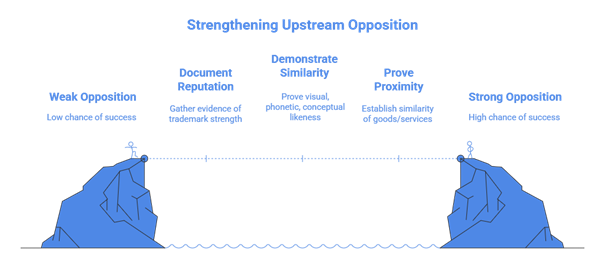
To maximise the chances of success in an opposition based on confusion or reputation, it is essential to:

  • Document the reputation of the earlier trademark: association studies, surveys, turnover figures, market share data
  • Demonstrate similarity between the signs (visual, phonetic, conceptual)
  • Prove proximity or similarity of the goods and services
  • Establish the existence of a mental link with the earlier trademark when invoking damage to reputation

strengthening opposition trademark

Where one of these elements is missing or weakened, the opponent’s position is significantly undermined, as illustrated in the Versailles Court of Appeal decision of October 22, 2025.

Facts and procedural background of the October 22, 2025 decision

The earlier trademark: “COCO”

Chanel owns the verbal trademark “COCO,” covering soaps, perfumery and cosmetics in Class 3. The trademark enjoys significant public recognition as a direct reference to the Chanel universe and forms the basis of the opposition.

The contested trademark: “COCO SHAOUA” (classes 3 and 4)

A trademark application for the verbal sign “COCO SHAOUA” was filed for goods in Class 3 (cosmetics) and Class 4 (candles). Chanel contested the application on two grounds:

  • A likelihood of confusion regarding Class 3 goods
  • Damage to the reputation of the earlier trademark “COCO,” particularly in relation to Class 3 goods.

Opposition Before the INPI and the Director General’s Decision

Chanel filed an opposition before the French IP Office (INPI) against “COCO SHAOUA.”
The INPI Director General, while acknowledging the reputation of the earlier “COCO” trademark, rejected the opposition. He found that the signs were insufficiently similar to give rise to a likelihood of confusion and thus allowed the registration of “COCO SHAOUA.”

Chanel’s appeal before the Court of Appeal

Following the rejection, Chanel lodged a cancellation action before the Versailles Court of Appeal. The company argued that “COCO” was highly distinctive visually, phonetically and conceptually, and that “COCO SHAOUA” created both a likelihood of confusion and damage to reputation.

The Court delivered its decision on October 22, 2025.

The Court of Appeal’s assessment of likelihood of confusion

Similarity of the signs

Chanel argued that “COCO SHAOUA” incorporated the sequence “COCO” in its attack position, leading consumers to associate it instantly with the earlier trademark. The company also contended that the syllable “SHA” could phonetically evoke “CHANEL,” reinforcing a conceptual association.

The Court held otherwise. It noted that the word “coco,” when used as a common noun (e.g., as an ingredient or scent), does not function exclusively as a distinctive sign for Chanel in the mind of consumers. It further considered that the fantasy term “shaoua” was equally prominent within the sign “COCO SHAOUA,” such that the trademark would be perceived globally.

The Court therefore concluded that the visual differences (one word vs. two words), phonetic differences (two syllables vs. four), and conceptual differences between the signs were sufficient to exclude similarity.

Proximity of the goods

The Court acknowledged that the goods in Classes 3 and 4 were similar or closely related to those covered by the earlier trademark, which could, in principle, reinforce the likelihood of confusion. However, the lack of similarity between the signs prevailed: product proximity alone was insufficient to create confusion.

Conclusion: no likelihood of confusion

The Court rejected Chanel’s claim on likelihood of confusion, holding that the company had not demonstrated that “COCO SHAOUA” would be perceived as originating from, or linked to, Chanel by the relevant public.

The Court of Appeal’s assessment of damage to reputation

Recognition of the reputation of “COCO”

The Court confirmed that “COCO” benefits from recognised reputation, as acknowledged by the INPI. This reputation gives rise to autonomous protection under Article L. 713-3 CPI, allowing action even without confusion, where the contested sign creates dilution or parasitism.

Low intrinsic distinctiveness of the term “COCO”

However, the Court emphasised that the term “coco” is a common, polysemous noun (e.g., coconut, ingredient, scent), resulting in limited intrinsic distinctiveness. Reputation alone cannot compensate entirely for this weakness.

Assessment of “COCO SHAOUA” and lack of mental link

The Court found that the combination of “coco” with the fantasy term “shaoua” did not create a mental link with the earlier trademark “COCO.”

As the existence of such a link is a prerequisite under Article L. 713-3 CPI, the claim for damage to reputation could not succeed.

Conclusion: no damage to reputation

The Court therefore dismissed Chanel’s claim, finding no confusion and no dilution of the earlier reputed trademark.

To learn more about the scope of protection for a trademark’s reputation, please see our previously published article.

Conclusion

The Versailles Court of Appeal decision of October 22, 2025 demonstrates that the protection of a well-known earlier trademark does not dispense with a thorough assessment of sign similarity and the overall perception of the contested trademark. Despite Chanel’s reputation, the Court held that “COCO SHAOUA” was sufficiently distinct from “COCO” to exclude both confusion and dilution.

For trademark owners, this decision underscores the need for vigilance and meticulous preparation when engaging in opposition proceedings.

Dreyfus & Associés assists its clients in managing complex intellectual property cases, offering personalized advice and comprehensive operational support for the complete protection of intellectual property.

Dreyfus & Associés works in partnership with a global network of attorneys specializing in Intellectual Property.

Nathalie Dreyfus with the support of the entire Dreyfus team


FAQ


1. Can an opposition be based solely on damage to reputation without likelihood of confusion?

Yes. Article L. 713-3 CPI allows action against a sign that damages the reputation of an earlier trademark even where no likelihood of confusion exists, provided that the earlier trademark’s reputation is proven and that a mental link is established.

2. Does a trademark consisting of a first name or nickname automatically benefit from enhanced protection?

No. Even a famous first name does not necessarily acquire strong distinctiveness. Courts evaluate its intrinsic character: a common first name, even if associated with a public figure, may remain weakly distinctive. Reputation does not convert a common word into a strongly distinctive trademark.

3. Does the presence of a generic term within a composite sign always prevent a likelihood of confusion?

No. A generic term may remain dominant if the rest of the sign is descriptive or secondary. It depends on the overall impression. In this case, the fantasy element “shaoua” neutralised the impact of “coco,” but other cases have found confusion despite a generic term where the dominant attack remained preponderant.

4. What types of evidence best support the existence of a mental link in reputation-based actions?

The most persuasive evidence includes recent market studies, association surveys, media exposure analytics and demonstrations of likely marketing free-riding. Judges accord significant weight to robust, recent and verifiable data.

5. Can a weakly distinctive trademark still be protected effectively?

Yes, provided the owner demonstrates either extensive use leading to acquired distinctiveness, or an arbitrary character in the relevant market.


This publication is intended to provide general guidance to the public and to highlight certain issues. It is not designed to apply to specific situations, nor does it constitute legal advice.

Read More

Position marks in the European Union: between visual innovation and legal protection

Introduction

The evolution of trademark law in Europe has enabled the emergence of new forms of distinctive signs, adapted to companies’ visual strategies. Among these, the position mark stands out as a still relatively uncommon category, though one whose use and recognition are steadily increasing before European offices and courts.

This type of trademark, which lies at the intersection of design and traditional trademarks, protects the specific way in which a sign is affixed to a product. The European Union has regulated this concept through the European Union Trademark Regulation (EUTMR) and the EUIPO guidelines, in order to define its limits and guarantee legal certainty for economic operators.

Definition and characteristics of position marks

According to the EUIPO, a position mark is defined as a sign “consisting of the specific manner in which the mark is placed or affixed to the product.”

The graphic representation must clearly identify the position, size, and proportion of the sign in relation to the product concerned.

To be admissible, the graphic representation of the trademark application must:

  • Be precise, intelligible, and objective.
  • Include, where applicable, dotted lines to distinguish unprotected elements.
  • Avoid any vague descriptions suggesting that the position of the sign could vary depending on the products.

Thus, protection covers not only the sign itself, but also the combination of that sign and its particular positioning on the product.

Conditions of validity before the EUIPO

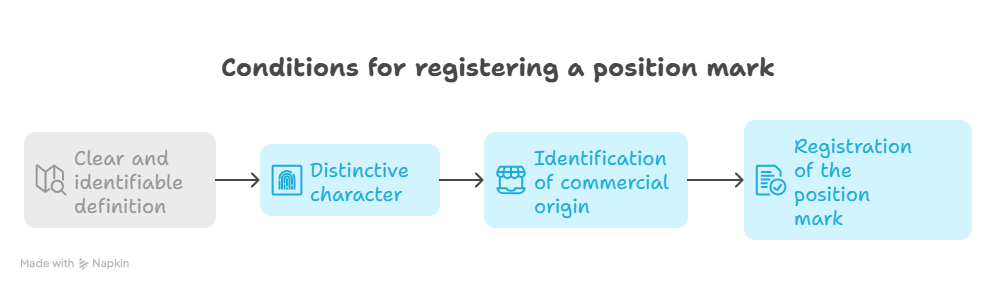
To be registered, a position mark must meet the conditions of validity set out in Article 7(1)(a) and (b) of the EUTMR, namely:

  • Be clearly defined and identifiable.
  • Have distinctive character, enable consumers to identify the commercial origin of the goods.

The EUIPO ensures that the representation filed allows any economic operator to understand the scope of protection without ambiguity. A sign that is purely decorative, generic, or inseparable from the usual appearance of the product may be refused. Case law thus reminds us that a position mark must not be confused with a simple design or aesthetic element.

conditions registering mark

The Airwair International Limited case

In a decision handed down on August 12, 2025, the EUIPO Cancellation Division ruled in the case Mtng Europe Experience, S.L.U. v. Airwair International Limited, regarding the famous yellow heel loop on Dr. Martens shoes.

Mtng Europe Experience, challenged the validity of the position mark registered by Airwair, described as a black and yellow buckle affixed to the back of the shoe, accompanied by contrasting yellow stitching.

The EUIPO reiterated that the representation of a trademark must be clear, precise, and durable, allowing for unambiguous identification of the protection conferred.

In this case, the Cancellation Division ruled that the trademark met these criteria and rejected the request for cancellation, considering that the visual element and its position gave the product a strong distinctive character.

This decision confirms the possibility of protecting an iconic visual positioning when it serves as an indication of commercial origin.

Practical issues for rights holders

For businesses, position marks offer valuable protection against the imitation of distinctive visual elements. They extend the protection afforded by the design or shape of the product by specifically targeting the location of a distinctive sign.

However, their success depends on a rigorous filing strategy:

  • Describe the position of the sign precisely;
  • Avoid any confusion between aesthetic function and function of origin;
  • Ideally, secure the trademark application with proof of use and public recognition.

Trademark owners must therefore work hand in hand with specialized IP counsels to secure the scope of their applications and avoid any cancellation based on lack of clarity or distinctiveness.

Conclusion

Position marks represent a major evolution in trademark law, adapted to contemporary visual and marketing realities.

The Airwair case illustrates the importance of rigorous and consistent representation to ensure the validity of such a registration.

By combining visual innovation and legal rigor, position marks enable companies to protect not only their identity, but also the way they present it to the public.

Dreyfus & Associés assists its clients in managing complex intellectual property cases, offering personalized advice and comprehensive operational support for the complete protection of intellectual property.

Dreyfus & Associés works in partnership with a global network of attorneys specializing in Intellectual Property.


Nathalie Dreyfus with the support of the entire Dreyfus team


Q&A


1. What is a position mark?

A position mark protects the specific way in which a sign is affixed to a product, rather than the sign itself. It is therefore distinct from figurative or three-dimensional marks.

2. What are the criteria for the validity of a position mark ?

It must be clear, precise, and sufficiently distinctive to enable consumers to identify the origin of the product.

3. What is the difference between a position mark and a design ?

A design protects the aesthetic appearance of a product, while a position mark protects the commercial origin associated with a particular visual positioning.

4. Can position mark protection and design protection be combined ?

Yes, both types of protection can coexist if they serve different purposes: one aesthetic, the other distinctive.

5. Why register a position mark ?

To prevent imitations and strengthen the protection of iconic visual elements that contribute to a brand’s identity, such as a seam, a stripe, or a distinctive location.

Read More

What is Habeas Data, the guardian of health personal data?

Introduction

The term Habeas Data echoes the centuries-old principle of Habeas Corpus, transposing the protection of individual freedoms into the immaterial sphere of personal data. In the age of digital medicine and global circulation of medical information, Habeas Data serves as a true guardian of personal health data, ensuring each individual’s right to access, control, and correct the information relating to their most intimate sphere: their health.

The origins of Habeas Data

Historical context and legal philosophy

Habeas Data emerged in the 20th century in Latin America as a constitutional remedy, allowing individuals to protect themselves against the abusive collection, use, or storage of their data. It enshrines the principle that personal data, like individual liberty, must be protected against arbitrary interference.

Recognition in latin american constitutional systems

Countries such as Brazil, Colombia, and Argentina have incorporated Habeas Data into their constitutions, granting citizens the right to access, rectify, or delete personal data held by public or private entities. This mechanism has served as a model for broader debates on digital sovereignty.

Definition of Habeas Data and health data

What Habeas Data covers

Habeas Data guarantees every individual the right to consult personal data held by third parties and to request its rectification or deletion if inaccurate or unlawfully processed. It is a procedural right that enshrines the principle of informational self-determination.

Clarifying the notion of health data

Under Article 4(15) of the GDPR, health data is defined as personal data related to the physical or mental health of a natural person, including the provision of health care services, revealing information about their health status. Its specificity lies in its highly sensitive nature, as it can impact dignity, employment, insurance, or individual freedom.

Why Habeas Data is essential for health data

Sensitivity and risks of misuse

Health data is classified as a special category of data. Unauthorized disclosure can have serious consequences, such as denial of insurance, stigmatization, workplace discrimination, or reputational harm.

Safeguarding dignity, privacy, and autonomy

Habeas Data functions as a constitutional safeguard that keeps health data under the individual’s exclusive control. It strengthens privacy, personal autonomy, and informational integrity, especially at a time when electronic medical records and digital health platforms are becoming widespread.

Distinction from European mechanisms such as the GDPR

Points of convergence

Both Habeas Data and the General Data Protection Regulation (GDPR) pursue similar objectives: transparency, purpose limitation, and rights of access, rectification, and erasure. Both are based on the principle of giving individuals control over their personal data.

Key differences in scope and application

The essential difference lies in their legal nature. The GDPR is a regulation applicable across the European Union, imposing obligations on data controllers. Habeas Data, on the other hand, is a constitutional right directly enforceable before the courts, providing citizens with an effective remedy.

Strategic and legal challenges

Why Habeas Data was established

This mechanism was designed to limit the growing power of institutions and corporations handling sensitive data, particularly in the healthcare sector. It ensures that individuals retain control over information that can directly affect their privacy and decision-making.

Anticipating the challenges of health data protection

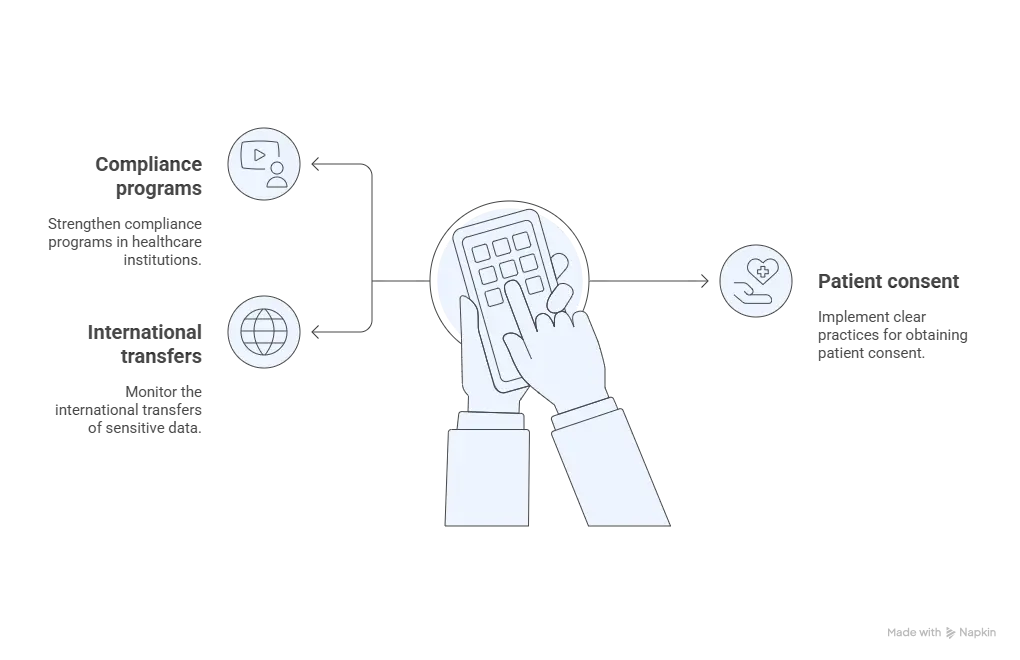
Protecting health data now intersects with cross-border data flows, artificial intelligence, and digital platforms. An effective strategy requires:

  • strengthening compliance programs in healthcare institutions,
  • implementing clear patient consent practices,
  • monitoring international transfers of sensitive data.

challenges data protection

Conclusion

Habeas Data acts as a constitutional shield for health data, complementing and sometimes surpassing European mechanisms such as the GDPR. Its procedural dimension strengthens the effective protection of individuals in an increasingly digital society.

Dreyfus Law firm assists its clients in managing complex intellectual property cases, offering personalized advice and comprehensive operational support for the complete protection of intellectual property.

Dreyfus Law firm is partnered with a global network of lawyers specializing in intellectual property.

Nathalie Dreyfus with the assistance of the entire Dreyfus team.

FAQ

1. What is Habeas Data in simple terms?
It is a right allowing any person to access their personal data and request its correction or deletion.

2. Why is Habeas Data particularly important for health data?
Because such data is extremely sensitive, and its misuse may cause discrimination, financial loss, or harm to dignity.

3. What is the difference between Habeas Data and the GDPR?
The GDPR is a European regulation imposing obligations, while Habeas Data is a constitutional right directly enforceable in court.

4. Does the GDPR also protect health data?
Yes, it classifies health data as “sensitive data,” requiring explicit consent and enhanced safeguards.

5. Which countries recognize Habeas Data?
Notably Brazil, Argentina, and Colombia, where it is enshrined in the Constitution.

Read More

Avoiding the accidental franchise and licensing pitfalls

Introduction

In an increasingly complex legal environment, a trademark license agreement may be reclassified as a franchise, leading to significant legal and financial consequences. This situation, referred to as an “accidental franchise,” often arises when businesses expand internationally without anticipating the specific legal obligations that apply to franchises. This article highlights the risks, red flags, and best practices to secure licensing agreements.

What is an accidental franchise?

An accidental franchise occurs when a company believes it is granting a simple trademark license, but the contractual provisions and actual practices meet the legal criteria of a franchise.

Under French law, a franchise generally implies:

  • The provision of a trademark or distinctive sign.
  • Payment of remuneration by the franchisee.
  • The transfer of substantial know-how and ongoing assistance.

By contrast, a trademark license, is limited to authorizing the use of the sign under quality control, with exploitation restricted to a given territory, without any operational supervision of the licensee. The line is subtle but decisive.

franchise license

Legal and financial risks of reclassification

Reclassifying a license as a franchise may result in:

  • Regulatory sanctions: nullity of the contract or fines in the absence of pre-contractual disclosure documents or required formalities.
  • Civil liability: claims for damages by franchisees, reimbursement of amounts paid.
  • Tax risks: reassessments concerning the nature of royalties.
  • Damage to brand image: publicity of disputes and loss of credibility.

Illustrative example: A French fashion company imposes a uniform store design and mandatory marketing strategy on its licensees. The court reclassifies the agreements as franchise contracts, leading to their nullification and compensation to franchisees.

Warning signs in licensing agreements

a) Excessive control over the licensee

Clauses imposing management methods, pricing policies, or detailed operating manuals.

b) Fees resembling franchise entry fees

Upfront payments for training, advertising, or assistance.

c) Rigid territorial exclusivity

Agreements tied to strict marketing obligations.

d) Continuous mandatory assistance

Permanent transfer of know-how and ongoing supervision.

Best practices to secure agreements

  • Anticipate local laws: review franchise legislation before drafting a license agreement.
  • Limit assistance: focus only on trademark use and compliance with quality standards.
  • Clear drafting: specify financial obligations to avoid assimilation with franchise entry fees.
  • Rely on specialized counsel: intellectual property and franchise lawyers can adapt contracts to local requirements.
  • Regular audits: periodically review agreements to ensure compliance with evolving regulations.

Case study: A French cosmetics start-up structured its foreign licensing agreements with specialized legal advice. By limiting obligations to quality control, it avoided reclassification as a franchise and safeguarded its business model.

Conclusion

Avoiding the accidental franchise is a strategic issue for protecting brand value and ensuring the legal security of licensing agreements. Increased vigilance and carefully drafted contracts can prevent disputes and optimize commercial expansion.

Key takeaway: clearly distinguishing between a license and a franchise is essential to secure operations and preserve reputation.

Dreyfus Law firm assists its clients in managing complex intellectual property cases, offering personalized advice and comprehensive operational support for the complete protection of intellectual property.

Dreyfus Law firm is partnered with a global network of lawyers specializing in intellectual property.

Nathalie Dreyfus with the assistance of the entire Dreyfus team.


FAQ


What distinguishes a franchise from a trademark license?
A franchise involves a complete business concept with assistance and control, while a license is limited to the use of a trademark under quality control.

What is an “accidental franchise” in practice?
An accidental franchise occurs when a license agreement is reclassified as a franchise due to failure to comply with legal formalities.

What are the main risks for the company in case of reclassification?
The risks include the nullity of the contract, financial penalties, and the liability of the licensor.

What obligations do franchisors have in France?
Franchisors must provide the pre-contractual disclosure document (DIP, under the Doubin Law), transfer know-how, and ensure ongoing assistance.

What warning signs should be identified in a contract?
Overly detailed operating obligations, excessive control, or the existence of imposed confidential know-how.

How can an operating manual be prevented from being treated as franchise know-how?
By limiting the manual to quality standards without conveying structured confidential know-how.

Read More

Customs Seizure: A Strengthened Strategic Tool for Intellectual Property Rights Holders

The fight against counterfeiting and infringements of intellectual property rights remains a major economic, legal, and security challenge, affecting all sectors : fashion, luxury goods, technology, pharmaceuticals, and consumer products alike. Every year, French customs authorities intercept millions of counterfeit goods, representing a significant loss of revenue for rights holders and a tangible risk to consumer safety and health.

In this context, proactive customs action has become a cornerstone of rights enforcement. Under Regulation (EU) No. 608/2013 and its national transposition, notably the French Customs Code and the French Intellectual Property Code, customs authorities have, for several years, held the power to initiate seizures on their own initiative whenever they detect suspicious goods, even in the absence of a prior request from the rights holder. This power, now fully embedded in operational practice and supported by internal administrative guidelines, has profoundly reshaped customs enforcement strategy: it strengthens responsiveness, optimises prevention, and provides an effective mechanism to stem the inflow of counterfeit products into the market.

When mastered and combined with close cooperation between rights holders and customs, this system can serve as a genuine legal and operational shield for any business seeking to protect its intangible assets.


Context and evolution of the legal framework

Customs seizure is a vital tool in the fight against counterfeiting and the illicit importation of goods infringing intellectual property rights. Historically, customs intervention often required an explicit request from the rights holder. However, European and national legislation has progressively expanded the powers of customs administrations, enabling them to act ex officio when they identify suspicious goods, in accordance with Regulation (EU) No. 608/2013 and Articles L. 521-1 et seq. of the French Intellectual Property Code.

In France, customs authorities may initiate a seizure whenever there is objective evidence suggesting a potential infringement. This interpretation offers a major strategic advantage to rights holders, who thus benefit from proactive protection.


Conditions and procedure for implementation

Seizure initiated by customs authorities

A seizure may be triggered in two ways:

  • Following a prior application for action filed by the rights holder, valid for a set period and renewable.
  • Through spontaneous detection by customs, even without a prior application, where clear signs of counterfeiting or infringement are identified.

Customs services then act without delay to prevent the goods from being dispersed, securing them in designated storage facilities.

Rights and obligations of the rights holder

Once the seizure has been carried out, the rights holder is promptly notified and is granted:

  • A period of 10 working days (extendable) to initiate legal proceedings or confirm the infringement.
  • The option to request simplified destruction if the declarant or holder of the goods does not oppose the seizure.

In return, the rights holder must provide proof of their rights (registration certificates, evidence of use where applicable) and work closely with customs to qualify the goods.


Practical advantages for rights holders

The expansion of customs’ role brings several key benefits:

  • Greater responsiveness: action is possible even without an initial request.
  • Early interception of counterfeit flows before they reach the market.
  • Time and resource savings for rights holders, enabling them to focus on litigation stages.
  • Enhanced deterrence: infringing importers know that monitoring is continuous.


cycle customs benefits


Limitations and precautions

Despite these advantages, certain precautions remain essential:

  • Keep customs applications for action up to date to cover all product categories and countries of origin.
  • Provide customs with detailed product identification sheets to facilitate rapid detection.
  • Anticipate costs and timelines linked to legal proceedings if the seizure is contested.
  • Be aware of the risk of unjustified detention and the need to verify the infringement promptly.


Conclusion and outlook

The ability of customs authorities to initiate seizures on their own initiative significantly strengthens the protection of intellectual property rights. Combined with proactive cooperation between rights holders and customs, this power can substantially reduce the inflow of counterfeit goods into the territory.

The European legal framework may evolve further in the coming years, particularly to reinforce cooperation between Member States and improve information sharing.


Dreyfus Law Firm is in partnership with a global network of attorneys specialising in Intellectual Property.

Nathalie Dreyfus, with the support of the entire Dreyfus team.


FAQ


1. What is a customs seizure?

It is the detention by customs authorities of goods suspected of infringing an intellectual property right.

2. Can customs act without a request from the rights holder?

Yes, if there is objective evidence of counterfeiting.

3. What is the deadline to act after notification of a seizure?

Generally 10 working days, with the possibility of extension.

4. What documents must be provided to customs?

Registration certificates, evidence of use, and detailed product identification sheets.

5. Does this mechanism apply to all forms of intellectual property?

Yes, including trademarks, designs and models, copyright, patents, and geographical indications.

Read More

Video Games: China strictly sanctions reskinning on the grounds of unfair competition

What is game reskinning?

Game reskinning involves copying the structure, logic, gameplay, algorithms, and mechanics of a game, while simply changing its appearance (graphic design, characters, sound interface) to give the illusion of a new game.

This practice, common in China, aims to reuse a successful gameplay without bearing the development cost or creative risk. As a result, it leads to “disguised” copies that seriously harm the legitimate rights holders.

Why is reskinning problematic?

  • Consumer confusion: Players often fail to distinguish the original game from the copy.
  • Harm to investment: Clones unfairly exploit the research and development (R&D) work of others.
  • Revenue loss: Clones divert downloads and user engagement.
  • Stifling innovation: By reducing the value of original creations, reskinning hinders technological progress.

ddddd

  1. The response of Chinese courts

3.1 A structuring case law

In the case of Rise of Kingdoms vs Commander (2024), the Guangdong High People’s Court condemned the company Jiujiu to more than 10 million yuan (USD 1.6 million) for copying the game mechanics of a competitor, while also copying the graphics from Age of Empires.
The court found that this combination—copying the “bones” (mechanics) and the “skin” (visuals) from two games—constituted parasitic behavior under Article 2 of the Chinese anti-unfair competition law (AUCL).
Three criteria were established:

  1. Originality and competitive importance of the copied elements;
  2. Extent of the reproduction compared to industry practices;
  3. Bad faith or violation of honest business practices.


3.2 An evolving legal framework

Chinese courts have evolved: initially protective via copyright law (for software or audiovisual works), they now increasingly apply unfair competition law to sanction the abusive use of gameplay.
The Supreme Court also published a guideline in December 2024 on the judicial protection of technological innovation, recommending the broad application of AUCL clauses to fight “free riding” (Effortless gain) in innovative sectors.


What can developers and rights holders do?

  • Document the creation process: design documents, code versions, aesthetic choices.
  • Register protectable elements: trademarks, designs, interfaces.
  • Implement proactive monitoring: detect clones on app stores.
  • Build a strong evidence case: visual comparisons, confusion tests, economic data.
  • Combine legal grounds: copyright, unfair competition, trade secrets.


Conclusion

Chinese courts mark a turning point in the fight against game reskinning, relying not only on copyright law but also on an evolving interpretation of unfair competition law. This strategy, now supported by hefty financial sanctions, is a deterrent to parasitic behavior in the gaming industry.
Dreyfus Law firm assists its clients in managing complex intellectual property cases, offering personalized advice and comprehensive operational support for the complete protection of intellectual property.

Dreyfus Law firm is partnered with a global network of lawyers specializing in intellectual property.

Nathalie Dreyfus with the assistance of the entire Dreyfus team.


FAQ

  1. What is game reskinning?

    It is the practice of copying a game’s gameplay while only changing its appearance.

  2. Why do Chinese courts impose high damages?

    To compensate for competitive loss and penalize unfair practices.

  3. Are game mechanics protected by copyright?

    No, they are considered as ideas, but can be protected through unfair competition law.

  4. Does this case law apply to foreign games?

    Yes, as long as they are exploited in the Chinese market.

  5. What evidence is required?

    Screenshots, video comparisons, functional analyses, data on audience or revenue loss.


Read More

Patents and the question of AI as inventor: what are the prospects following recent decisions?

The rapid rise of artificial intelligence (AI) is profoundly transforming the landscape of innovation. AI systems are increasingly capable of generating original inventions, prompting a fundamental question: can AI be legally recognized as an inventor under patent law? Recent judicial rulings and ongoing debates highlight the tensions between technological progress and existing legal frameworks.

Current legal framework: must the inventor or author be human?

  1. The DABUS case: when artificial intelligence seeks inventorship rights

The DABUS case transcends a mere legal dispute; it encapsulates the tension between technological innovation and current law. DABUS (Device for the Autonomous Bootstrapping of Unified Sentience) is an AI system developed by Dr. Stephen Thaler. He argued that two inventions a fractal-structured food container and a signaling device were created without any human inventive input. Accordingly, he requested that DABUS be named as the sole inventor in patent applications filed worldwide.

Patent offices in the United Kingdom, United States, European Patent Office (EPO), Australia, and Germany rejected these claims outright. In all these jurisdictions, the law requires that only a natural person can be legally designated as inventor.

The UK Supreme Court grounded its decision on the Patents Act 1977, which explicitly states the inventor must be a “natural person.”

Similarly, the EPO ruled in decisions J 0008/20 and J 0009/20 (December 21, 2021) that, although Article 81 EPC requires naming an inventor, Articles 60(1) and 81 EPC together imply that only a natural person can hold this status.

Similarly, the EPO ruled in cases J 0008/20 and J 0009/20 (decisions dated December 21, 2021) that although Article 81 EPC requires the designation of an inventor, a combined interpretation of this provision with Article 60(1) EPC leads to the conclusion that only a natural person may be designated as inventor. The EPO emphasized that AI cannot hold or transfer rights, a fundamental prerequisite for patent entitlement. Thus, AI lacks the legal capacity to be recognized as inventor under the European Patent Convention.

In the United States, the Federal Circuit ruled in Thaler v. Vidal (2022) that the term “individual” in the Patent Act refers solely to natural persons.

To date, only South Africa has diverged. In 2021, its Companies and Intellectual Property Commission (CIPC) accepted a patent application listing AI as inventor. However, this remains a special case due to South Africa’s declaratory patent system lacking substantive patentability examination, limiting its international authority.

  1. Can AI be the author of a work? The U.S. Courts’ clear ruling

The question of human authorship also arises in copyright law. Dr. Thaler attempted to register an AI-generated work titled “A Recent Entrance to Paradise”, again naming the AI as sole author.

In March 2025, the U.S. Court of Appeals for the District of Columbia Circuit decisively held in Thaler v. Perlmutter that a machine cannot hold copyright.

Although the Copyright Act does not define “author,” the Court reasoned that the law’s spirit clearly envisions a human being capable of intent, choice, and ownership of exclusive rights from the moment of creation.

The Court further underscored that AI is merely a tool, not a legal subject. Creation occurs through the human who programs or operates the machine, not the machine itself.

Moreover, the U.S. Copyright Office has consistently maintained a human authorship requirement for copyright registration, aligned with longstanding copyright doctrine.


  1. The situation in France: an approach based on human originality

Under French and European law, copyright protection depends on originality understood as an expression of the author’s personality.

According to the Court of Justice of the European Union’s established case law (Infopaq, Painer, Funke Medien), a work is protectable only if the author exercised free and creative choices revealing personal intellectual effort.

AI, however advanced, has no legal personality, creative capacity, or intent. It merely executes algorithms.

Consequently, neither in France nor in the EU can a work entirely generated by AI currently qualify for copyright protection.

  1. Toward legal evolution?

These cases affirm that human authorship remains a fundamental principle of intellectual property law. While some advocate reform to recognize AI’s autonomous creative role, most legal systems favor preserving a personalist concept of creation.

This does not leave operators of AI-generated works without recourse. Unfair competition law, contractual protections, and civil liability may offer alternative safeguards. However, meaningful change requires clear legislative action rather than judicial reinterpretation.

Legal and economic challenges

Protecting innovations generated by AI

The refusal to recognize AI as inventor creates significant obstacles to protecting innovations. Companies investing heavily in AI-generated inventions face a legal gap. Without patent protection, these inventions risk exposure to unauthorized copying and loss of competitive edge.

This situation may also discourage investment in AI research and development, as companies could be hesitant to commit resources to technologies whose outcomes lack protection under intellectual property rights.

Implications for companies and investors

Legal ambiguity surrounding AI inventorship recognition could have serious economic consequences. Companies might be reluctant to commercialize AI-derived inventions, fearing litigation or inadequate protection. Likewise, investors may hesitate to finance innovative AI projects given the lack of legal clarity.

Future perspectives for patent law

Recognizing AI as co-inventor?

In light of these challenges, some experts propose evolving patent law to permit AI recognition as co-inventor alongside a human. This would acknowledge AI’s active role in invention while retaining human accountability. Such change would require legislative amendment and international harmonization. 

Adapting legal systems and professional practices

Legal systems might develop tailored mechanisms for AI-generated inventions, such as sui generis protection regimes designed to address their unique characteristics. Concurrently, IP professionals must adapt practices to assess and protect AI innovations effectively.

Conclusion

The question of AI recognition as inventor under patent law remains complex and contentious. Recent rulings uphold the necessity of a human inventor, yet technological progress pressures lawmakers to reconsider. Legal adaptation appears inevitable to keep pace with innovation and ensure effective protection of AI-generated inventions.

Dreyfus Law Firm works with clients in the food sector, providing specialist advice on intellectual property and regulatory issues to ensure compliance with national and European laws.

We collaborate with a global network of intellectual property attorneys.

Join us on social media !

LinkedIn  

Instagram

Nathalie Dreyfus with the support of the entire Dreyfus firm team.

FAQ

1. Can AI be recognized as an inventor in patent applications?

Currently, most jurisdictions require inventors to be natural persons.

2. What are the implications for companies innovating with AI?

They may face difficulties protecting AI-generated inventions, impacting innovation strategies and investments.

3. Are there any exceptions?

Only South Africa has accepted a patent naming AI as inventor, but this remains isolated and lacks substantive examination.

Read More