

Introduction
Since December 15, 2019, French law has applied Ordinance No. 2019-1169 of November 13, 2019, which transposed the EU Trademark Package Directive (Directive (EU) 2015/2436 of December 16, 2015). It reorganised the conditions for trademark validity, broadened the earlier rights capable of blocking an application and introduced, from April 1, 2020, an administrative invalidity procedure before the French Intellectual Property Office, the INPI.
A secure filing strategy must distinguish between three legal mechanisms:
- absolute grounds examined by the INPI,
- earlier rights relied upon by third parties in opposition proceedings and
- grounds for invalidating a registered trademark.
This distinction is essential for bad faith, which is not examined by the Office of its own motion at the application stage.
Why has the legal framework changed since 2019?
The final legislation replaced the draft discussed in the earlier article
Absolute grounds for refusal and invalidity are now listed in Article L. 711-2 of the French Intellectual Property Code. Earlier rights are principally addressed in Article L. 711-3, while Article L. 712-7 identifies the grounds on which the Director General of the INPI may refuse an application.
Graphical representation is no longer mandatory
The sign must still be represented clearly and precisely in the register, but the representation no longer has to be graphical. Sound, motion and multimedia trademarks may, for example, be filed using audio or video files. This development facilitates non-traditional filings without removing the requirement of distinctive character.
For further information on the registration of non-traditional trademarks, we invite you to read our article on this subject: “How can non-traditional trademarks be protected in France?”
Which grounds does the INPI examine of its own motion?
The sign must identify a commercial origin
The INPI may refuse a trademark that lacks distinctive character, is descriptive of the claimed goods or services, or consists exclusively of customary indications. The assessment depends on the sign, the relevant public and the specification. In certain cases, the applicant may prove that the sign acquired distinctive character through use before the filing date.
Functional or essential product characteristics remain unavailable
A shape or other characteristic resulting from the nature of the goods, necessary to obtain a technical result or giving substantial value to the goods cannot be monopolised as a trademark. In Gömböc, decided on April 23, 2020 (CJEU, April 23, 2020, Case C-237/19), the Court of Justiceconfirmed that the examination may rely on objective information identifying the essential characteristics of the shape.
Public policy, deception and protected emblems are also examined
In particular, in the absence of authorization, signs reproducing or imitating emblems, flags, official signs and hallmarks protected under Article 6ter of the Paris Convention, trademarks contrary to public policy or whose use is prohibited by law, as well as signs liable to mislead the public as to the nature, quality or geographical origin of the goods and services, may be refused.
The judgment in Fack Ju Göhte of April 23, 2020, referred to above, confirms that the assessment of accepted principles of morality must be contextual and based on the actual perception of the relevant public.
Can bad faith directly block an application?
A ground for invalidity, but not one examined of the INPI’s own motion
Article L. 711-2 11° of the French Intellectual Property Code provides that a trademark filed in bad faith cannot be validly registered. However, Article L. 712-7 does not include bad faith among the grounds examined by the INPI when deciding whether to refuse an application. Bad faith must therefore principally be relied upon after registration in invalidity proceedings, or before the courts where they retain jurisdiction.
Since April 1, 2020, any natural or legal person may request the invalidity of a French trademark before the INPI on this ground. Evidence must relate to the applicant’s intention at the filing date and may include knowledge of an earlier use, contractual relationships, a blocking strategy, the absence of a genuine commercial rationale or an intention to divert the functions of a trademark.
For any further information about bad faith, we invite you to consult our article: Complete Guide on Bad Faith in Trademark Cancellation Proceedings before the INPI.
How are geographical indications and plant variety denominations protected?
EU law has strengthened protection since 2019
Article L. 711-2 also covers designations of origin, geographical indications, traditional terms for wines and traditional specialities guaranteed. A trademark may be refused where its use would amount to misuse, imitation, evocation or exploitation of the reputation of a protected indication.
The framework has evolved through Regulation (EU) 2024/1143, which applies to wines, spirit drinks and agricultural products. Since December 1, 2025, Regulation (EU) 2023/2411 has also created an EU system for geographical indications for craft and industrial products. Later trademark applications incompatible with those rights must be refused.
Protection concerns the plant variety denomination
A trademark must be refused where it consists of an earlier protected plant variety denomination, or reproduces it in its essential elements, for a variety of the same or a closely related species. The ground concerns the denomination, rather than the plant’s general botanical characteristics.
Which earlier rights may support an opposition?
Opposition proceedings have been substantially broadened
Within two months of publication, an opposition may be based on an earlier trademark or a trademark with a reputation, but also on a company name, trade name, business sign or domain name whose scope is more than local, certain geographical indications, the name, image or reputation of a local authority, or the name of a public entity. Several rights belonging to the same holder may be relied upon in a single opposition.
Copyright, protected designs and personality rights may also affect the validity of a trademark, although they are not all directly available as grounds in administrative opposition proceedings. Depending on the legal basis and context, invalidity proceedings before the INPI or the competent court may be required.
How can the risk of refusal be reduced?
Pre-filing analysis must go beyond a search for identical trademarks
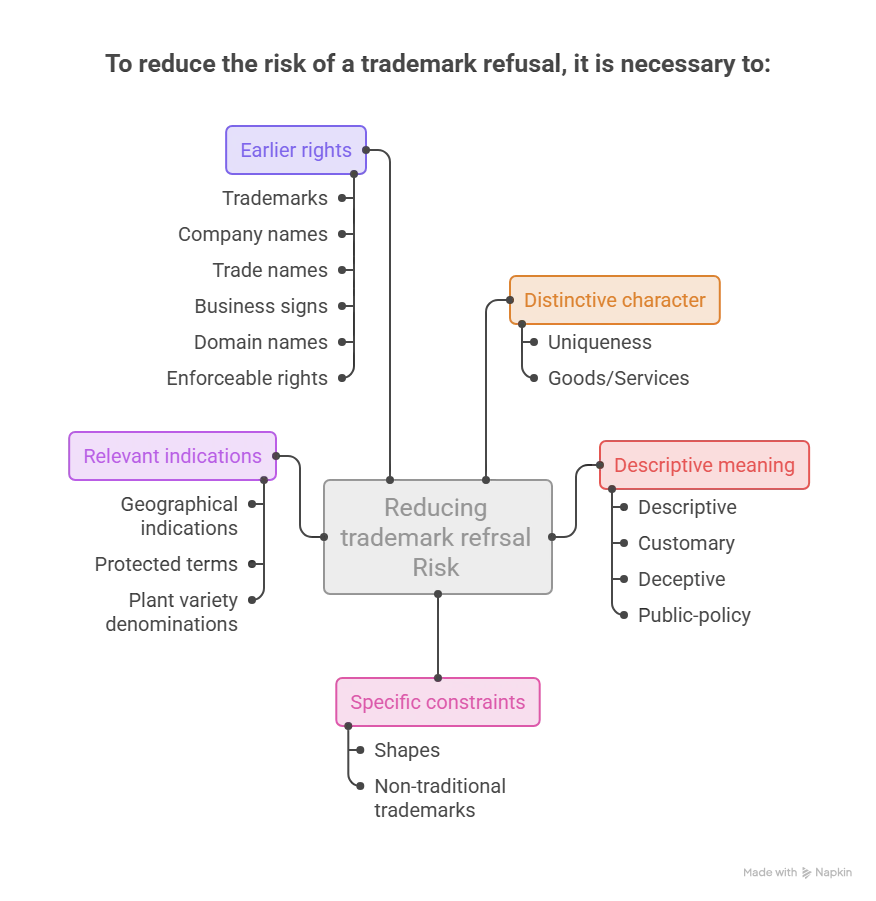
Before filing, we recommend checking:
- the sign’s distinctive character for each good or service;
- any descriptive, customary, deceptive or public-policy meaning;
- the specific constraints applying to shapes and non-traditional trademarks;
- relevant geographical indications, protected terms and plant variety denominations;
- earlier trademarks, company names, trade names, business signs, domain names and other enforceable rights.
Conclusion: anticipate objections before filing
The current framework is more structured than it was in 2019. The INPI examines the sign’s capacity to constitute a trademark, its distinctiveness, descriptive or customary character, certain functional characteristics, public policy, deception, protected emblems, geographical indications and plant variety denominations. Third parties also benefit from broader opposition and invalidity proceedings, including bad-faith claims.
Dreyfus Law Firm assists its clients in managing complex intellectual property cases, offering personalized advice and comprehensive operational support for the complete protection of intellectual property.
Nathalie Dreyfus, with the assistance of the entire Dreyfus team.
Q&A
Does a coexistence agreement guarantee registration of the trademark?
A coexistence agreement may help resolve a dispute between the parties, particularly through a limitation of the goods and services concerned. It does not, however, bind the INPI where an absolute ground for refusal remains applicable, for example where the sign is descriptive, deceptive or contrary to public policy.
Can a third party intervene without filing an opposition?
Within two months of publication of the application, any person may submit written observations to the INPI concerning certain absolute grounds for refusal. Unlike opposition proceedings, this procedure does not give the third party the status of a party to the proceedings.
Is a registered trademark necessarily available for use without risk?
Registration means that the trade mark has passed the INPI’s examination and, where applicable, the opposition period. It does not, however, guarantee that no earlier right may subsequently be asserted, particularly in invalidity or infringement proceedings.
Can the applicant amend the trademark to avoid refusal?
The sign as filed may not, in principle, be substantially altered during the registration proceedings. The applicant may, however, limit or withdraw some or all of the designated goods and services. Adding new goods or services requires a new application.
Can a refusal affect only some of the goods or services covered by the application?
Where the ground for refusal concerns only certain goods or services, the INPI may partially refuse the application and register the trademark for the remaining specification. It is therefore important to assess the precise scope of the objection before considering withdrawing the entire application.
This publication is intended for general public guidance and to highlight issues. It is not intended to apply to specific circumstances or to constitute legal advice.